A dental practice valuation multiple only means something when you know what it is multiplying.
A general practice may sell for roughly 60% to 90% of annual collections, 4.5x to 5.5x adjusted EBITDA for a larger solo or multi-provider office, or a lower multiple of Seller’s Discretionary Earnings (SDE). Those three figures can describe the same price. They look different because each one originates from a different number.
Mixing them up is one of the most expensive mistakes we see. A seller hears “five times” from a colleague, applies it to the wrong earnings figure, and walks into an offer conversation expecting a price no buyer will pay. Keep reading to learn more about dental practice valuation multiples and how EBITDA, SDE, and revenue multiples differ.
What Is the Difference Between EBITDA, SDE, and Revenue Multiples?
Each multiple answers a different question about the practice.
- Revenue multiple: What the practice sells for as a share of collections
- SDE multiple: What the practice is worth to one owner-dentist who will work in it full time
- EBITDA multiple: What the practice is worth as a business, after paying someone market rate to do the dentistry
The earnings figure decreases as you move down that list, so the multiple increases. That is the whole trick, and it is why a 2x and a 4.5x can point to the same number.
How Do Revenue Multiples Work for Dental Practices?
A revenue multiple, sometimes called a market multiplier, expresses value as a percentage of annual collections. It is the rule of thumb most dentists already know, and we cover where it comes from in our guide on how to value a dental practice.
It is useful as a sanity check. It is a poor pricing tool on its own because two practices with identical $1.2 million collections can have very different overhead, payer mix, and hygiene production. The one running at 58% overhead and the one running at 72% are not worth the same, and a revenue multiple cannot tell them apart.
What Is Seller’s Discretionary Earnings (SDE) in a Dental Practice?
SDE is the total financial benefit one owner takes out of the practice. It starts with pre-tax profit and adds back the owner’s salary, benefits, and personal or one-time expenses run through the business. The finance educators at Wall Street Prep lay out the standard SDE formula and its add-backs.
In dentistry, SDE fits the owner-operator buyer: an associate buying their first practice who will produce most of the dentistry themselves. Practices collecting under $1.5 million are often valued on SDE rather than EBITDA. If you are an associate weighing your first purchase, our buyer resources walk through how lenders read these numbers. Standard bank loans are most common for dental buyers. However, sometimes, first-time purchases are financed through SBA programs, where 7(a) loans cover changes of ownership up to $5 million.
What Is EBITDA and Why Do Buyers Adjust It?
EBITDA is earnings before interest, taxes, depreciation, and amortization. The Corporate Finance Institute has a clear primer on how EBITDA is calculated. Buyers of dental practices rarely use EBITDA at face value. They use adjusted EBITDA:
Adjusted EBITDA = EBITDA + owner add-backs − normalized owner compensation
That last line is where most of the negotiation happens. Normalized compensation is what it would cost to pay a dentist to do the owner’s clinical work. Most buyers set it as a percentage of the collections that dentistry produces, and 30% to 35% is the range we see most often. The ADA Health Policy Institute reports average general dentist income of $215,320 in 2025, which is a useful cross-check on where that percentage lands in dollars.
EBITDA is the language of group buyers. Private groups and dental service organizations price on it because they will staff the chairs with employed dentists, and the ADA reports that more than 1 in 4 dentists within 10 years of graduation were DSO-affiliated in 2024.
Ranges can run from 3x to 5x for larger solo and multi-provider practices, 5x to 7x for multi-location groups, and 7x and up for DSO-ready platforms. These are general ranges, and actual valuations vary with profitability, provider dependence, location, growth and buyer interest. With higher borrowing costs and tighter capital markets, multiples have also come down since 2020. There are many pros and cons of partnering with private equity, so it’s highly recommended that you consult with an advisor beforehand.
One Practice, Three Valuations: A Worked Example
Here is a single illustrative general practice with $1.2 million in collections, an owner who produces most of the dentistry, and operating expenses of $770,000 before any owner compensation.
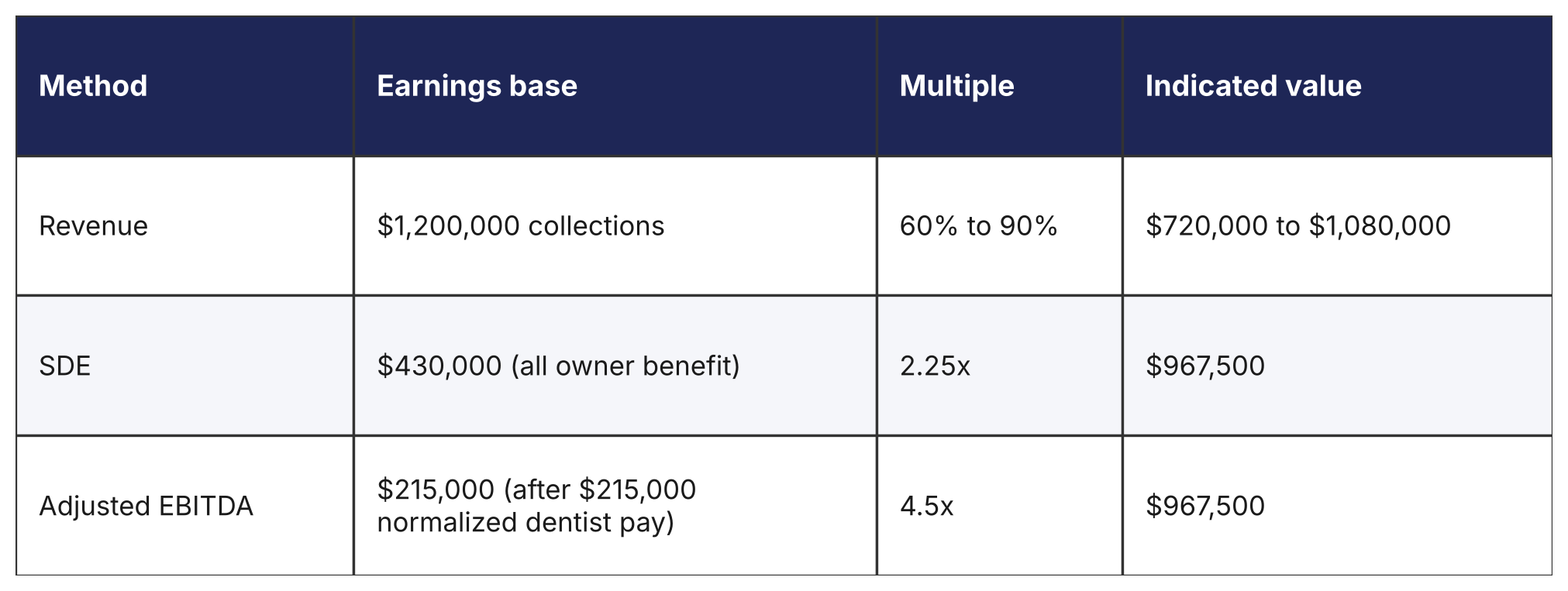
A practice this size would normally be priced on SDE. The EBITDA line shows how a group buyer would read the same books. The two land on the same price, and one multiple is half the other. Nothing changed except which number the multiple was applied to. Now picture a seller who applies the 4.5x EBITDA figure to the $430,000 SDE line. They expect $1.9 million for a practice that the market prices under $1.1 million.
These figures are illustrative, not an offer or appraisal. Your practice’s numbers depend on an official Broker Opinion of Value.
Which Valuation Multiple Applies to Your Practice?
The buyer most likely to purchase your practice decides which multiple matters.
- Selling to an associate or first-time owner: expect SDE, cross-checked against collections.
- Selling to a private group or DSO: expect adjusted EBITDA, and expect them to challenge every add-back.
- Any buyer: expect the revenue multiple to be used as a gut check on both.
Where you practice changes the buyer pool, too. Group interest looks different around Indianapolis than in a rural Wisconsin town where the likely buyer is a single dentist.
What Should You Do Before Getting Your Practice Valued?
Clean up the books before anyone applies a multiple. Separate personal expenses, document one-time costs, and know how much of production is yours versus your associates and hygienists. Our checklist on preparing your practice for a top valuation covers the specifics. If your sale is two or three years out, there is still time to raise the value of your practice before selling.
When you are ready, Lakeshore Dental Brokers can prepare a confidential valuation and tell you which multiple your likely buyers will use.